The Best Pre-Workout Routine for Maximum Results
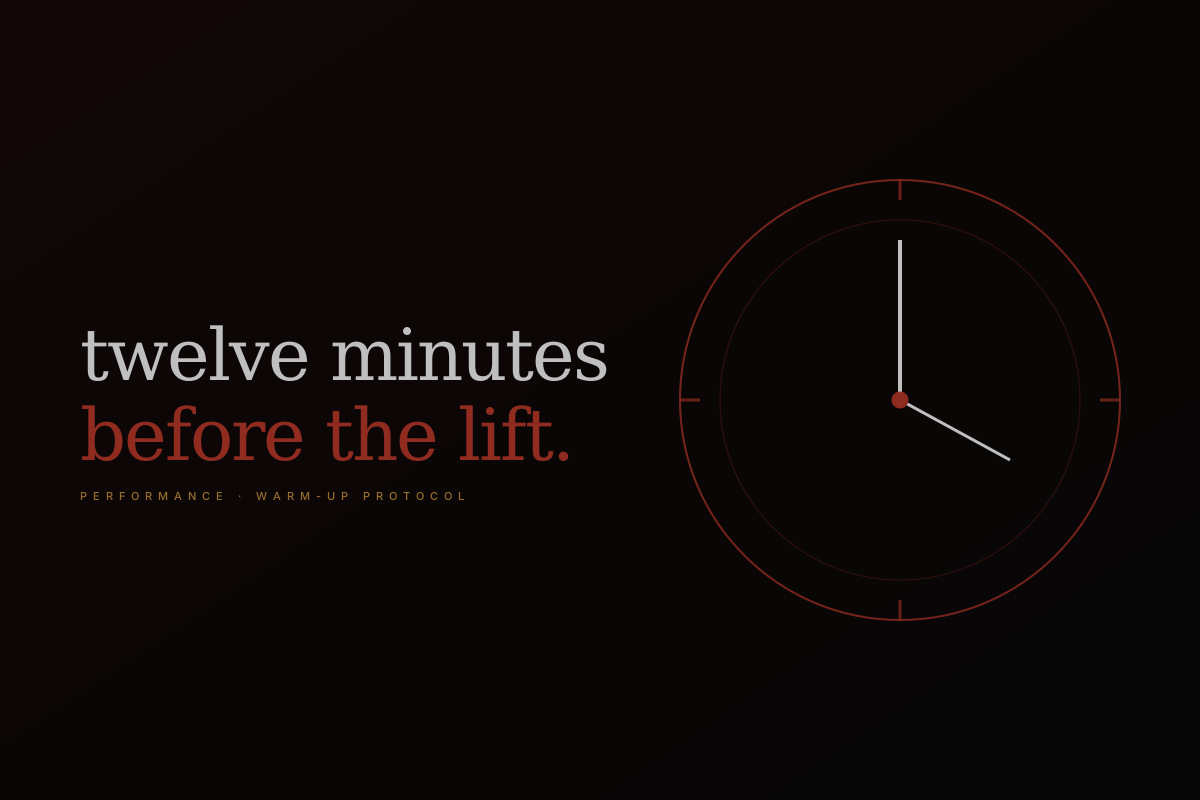
Most people walk into the gym, hit the treadmill for three minutes, and assume they're ready to lift. They aren't. A real pre-workout routine is twelve minutes long, deliberate, and structured — and it is the single biggest force-multiplier on the quality of the session that follows. Here is the exact protocol our coaches use on the floor.
01 Why twelve minutes?
Twelve minutes is the sweet spot. Long enough to actually raise your core temperature, mobilize joints, and prime your nervous system. Short enough that you don't fatigue yourself before the working sets begin.
Cutting your warm-up to five minutes might save time, but it costs you on the first three working sets — you will spend them warming up instead of working. Stretching it to thirty minutes drains the energy you need for hard lifts. Twelve is the calibration.
02 Minutes 1 to 4 — General heat
Start on a piece of cardio you actually like. Bike, rower, elliptical — anything that raises your heart rate without taxing your joints. The pace should be conversational, not race-pace. The goal is heat, not exhaustion.
Four minutes is enough to elevate core temperature by roughly one degree. That single degree changes everything — muscle elasticity improves, joint fluid viscosity drops, and your nervous system flips into a more responsive state.
"You are not warming up to feel ready. You are warming up to be ready."
03 Minutes 5 to 8 — Joint mobility
Move from general heat into joint-specific mobility. The pattern depends on your training day — but the principle is always the same. Take every joint involved in your upcoming session through its full active range of motion.
Lower-body day: deep bodyweight squats, hip circles, ankle rocks, hamstring sweeps. Push day: shoulder dislocates, scapular push-ups, thoracic rotations. Pull day: dead hangs, scapular pull-ups, banded face pulls.
Five to seven repetitions per movement is enough. You are oiling hinges, not training.
04 Minutes 9 to 12 — Nervous system priming
This is the most-skipped, most-important part. After your joints are loose, do two to three short, fast, explosive movements. Box jumps, broad jumps, medicine-ball throws, plyometric push-ups — anything sub-five seconds, sub-five reps, total effort.
Why? Because heavy lifting is a nervous system event before it is a muscular one. Priming the system with brief explosive output tells your brain: "we are about to ask for full output." The first working set after this primer feels noticeably more controlled and powerful.
Most lifters skip this because it feels unnecessary. Try it once. The difference on your first heavy set is immediate.
"A primed nervous system turns a heavy lift into a controlled one."
05 Specific warm-up sets
After the twelve-minute general routine, you still need lift-specific warm-up sets. The standard pattern is something like — empty bar for ten, 40% for five, 60% for three, 75% for one, 85% for one, then your first working set.
These are not training sets. They are rehearsals. The point is to feel the movement at progressively higher loads so your first heavy working set is the eighth time today, not the first time today, that you've performed the pattern.
06 A note on stimulants
Caffeine or a pre-workout supplement can help — especially for early-morning sessions when your nervous system is still half-asleep. Use it strategically. A standard dose, taken thirty minutes before training, is enough for most lifters.
But supplements are an accelerator, not a substitute. They will amplify a good warm-up. They will not rescue a skipped one. The twelve minutes still happens.
07 Putting it together
Walk in. Set a timer for twelve minutes. Four minutes of conversational cardio. Four minutes of joint mobility specific to today. Four minutes of explosive priming. Then specific lift warm-up sets. Then training.
It will feel slow at first. By session three, it will feel automatic. By session ten, you'll wonder how you ever trained without it.
Part of the FitNation Nepal team — writing, training, and shaping the way our community thinks about fitness.